

A severe, almost ecclesiastical cabinet by Danish artist Tage Andersen, made in iron and set with hand-made cobalt blue stained glass. Tall and narrow, its proportions feel more architectural than domestic – closer to an altar fragment than conventional storage.
The stained glass has been sandblasted, softening the surface and diffusing the light into dense, saturated planes, more in line with church glazing than decorative glass. It sits within a rigid, cross-braced iron frame, where sections of the metal have been abrasively finished – welds and joins lightly ground back and polished, catching the light against the darker, matte surface.
There’s a slight looseness to the making (which we adore) – edges not perfectly resolved, surfaces subtly uneven – which sits comfortably with Andersen’s hand rather than anything industrial. Loop-formed feet lift the piece from the ground, while linear, rod-formed finials introduce a restrained, almost devotional note.
There are traces of Gothic and Baroque influence, but stripped back – less ornament, more silhouette. Made by Andersen himself, the cabinet sits firmly within his language, where structure and theatre are held in balance.
Height: approx. 242 cm
Length: approx. 44 cm
Width: approx. 44 cm
Collection from Brixton, London or arranged delivery.
About the artist
Tage Andersen (b. 1947, Thy, Denmark) began as a self-taught florist before moving into furniture and interiors. In 1987 he opened Huset Tage Andersen in Copenhagen – part studio, part gallery, part shop – which became the centre of his practice. His work often combines hand-forged iron, stained glass and natural materials, typically made in small numbers or as one-off pieces.
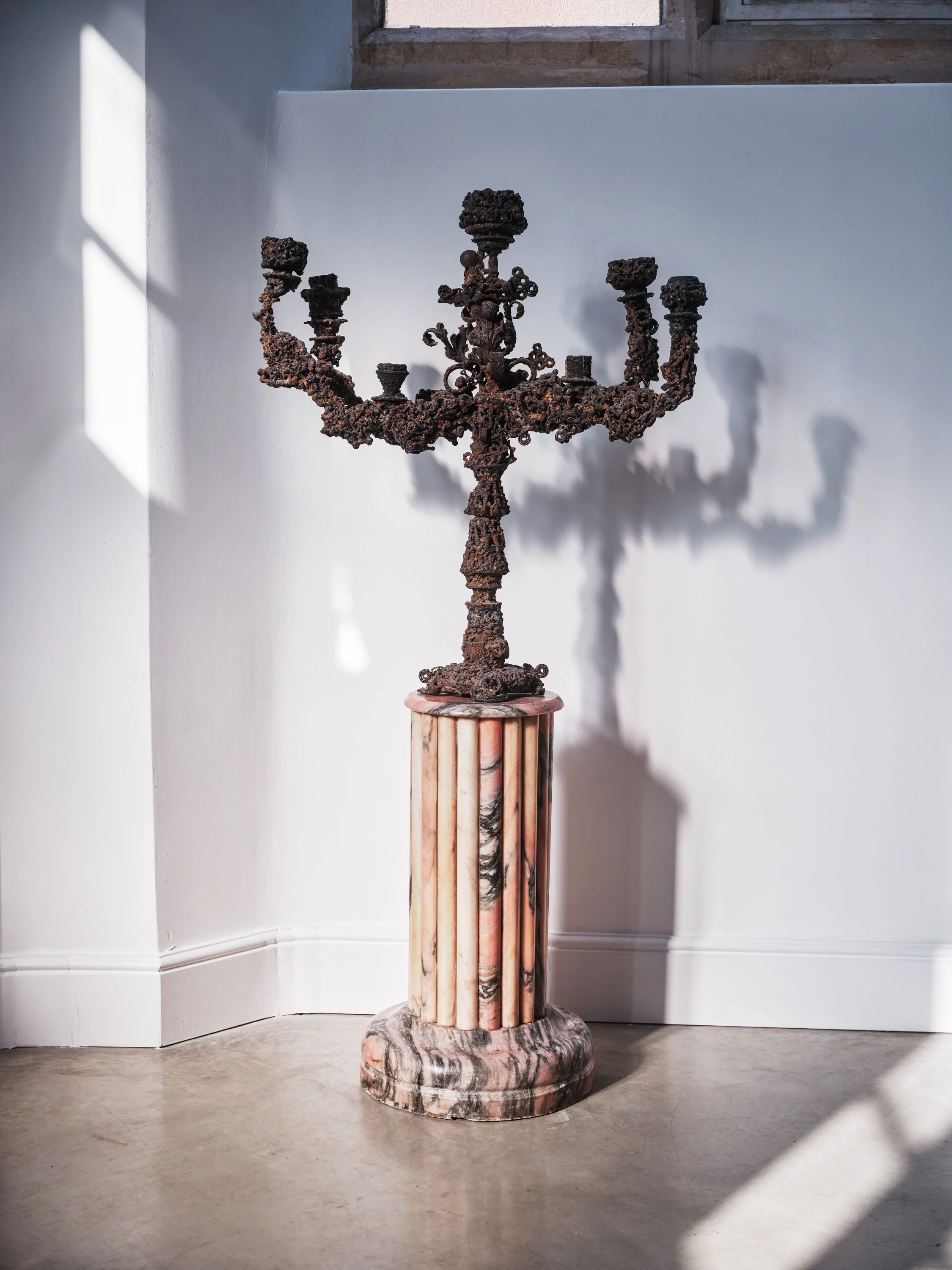
A nightmarish Brutalist creation by the German postwar artist Heinz Otterson. Built in 1970s Berlin, this candelabra recalls the coarse textures of his lithographs through welded and patinated rusted metal. Sizeable, and exploding with iron drippings, bike chain, musket balls and florets, it stands as a grotesque satire of baroque exuberance.
For rental use only. Contact us for rental details.
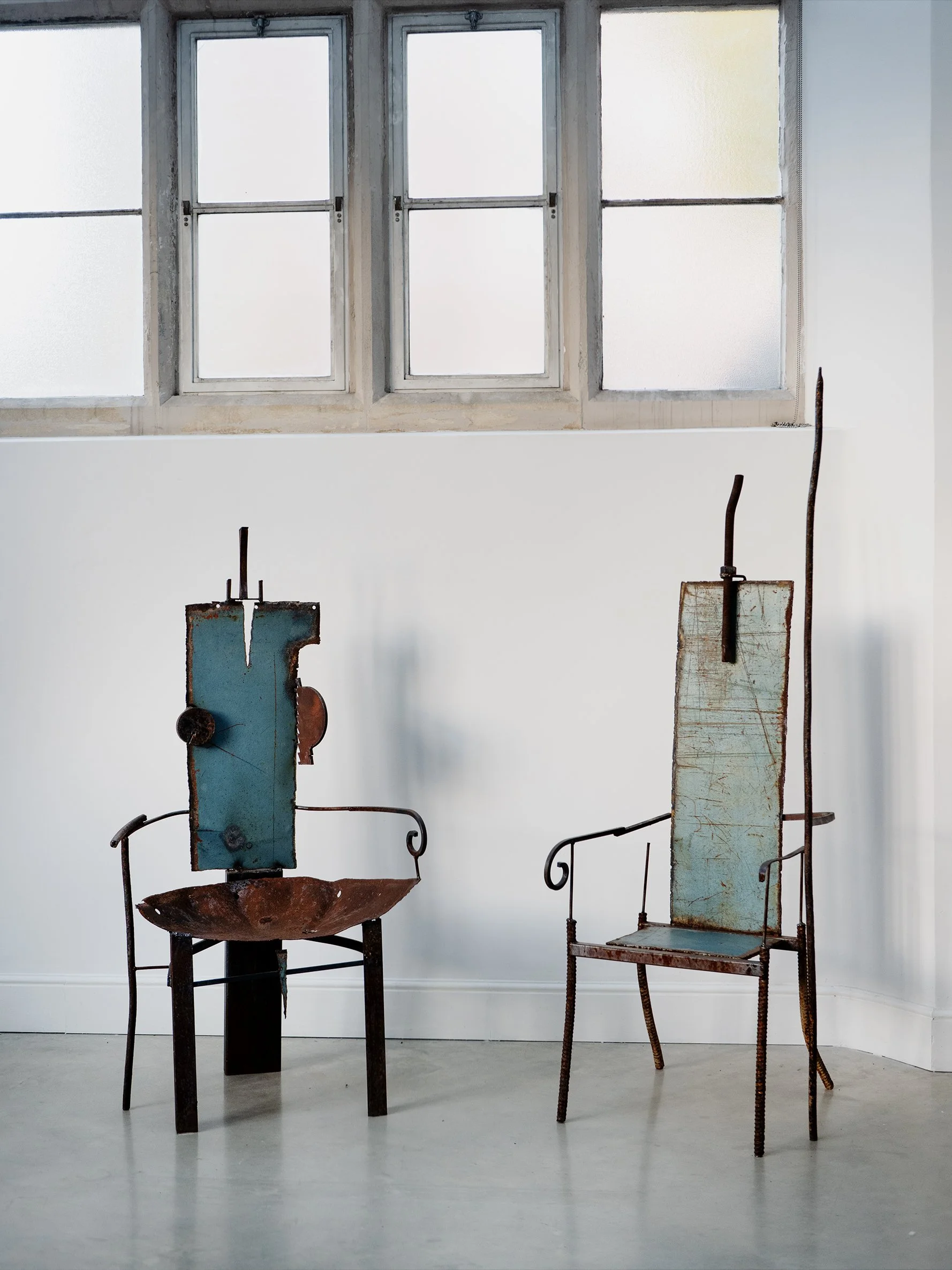
Though discovered in America, these two scrap metal thrones conjure the anarchic spirit of London’s Creative Salvage movement of the 1980s, with the same ferocious energy as Tom Dixon’s early welded furniture. In fact, we think they’re arguably better. Their anonymous maker only adds to their arcane and frankly pretty genius artistry.
Assembled from crudely cut sheet metal, welded rods and industrial fragments, one has a Cubist turquoise backrest and a rusted sink basin for a seat, complete with drainage holes and a jagged iron tooth cut from its back. Its companion carries a crooked iron spike for a staff, while a seemingly unattached armrest lends the heavy structure a bizarre weightlessness.
Like Tom Dixon, Mark Brazier-Jones and Nick Jones of Creative Salvage, alongside contemporaries Ron Arad, Danny Lane and André Dubreuil, these chairs reject polish and tradition in favour of experimentation, aggression and theatricality. Yet they appear to have arrived at this language entirely independently.
Trashy yet glamorous, brutal yet elegant, hand-built, outsider and resolutely unconventional. They are, in essence, sculptures you can sit on.
Unsigned. Maker and date unknown. Sold as a pair.
Iron Throne with Staff
Height of staff: 185 cm
Height of seat back (including rod): 165 cm
Width at base of legs: 54 cm
Depth of legs: 60 cm
Iron Throne with Basin Seat
Height: 150 cm
Width at base (widest point): 65 cm
Depth of base: 52 cm
Width across armrests: 77 cm
Collection from Brixton, London or arranged delivery.